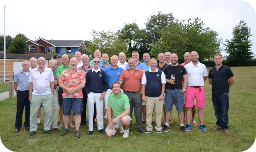
Copthorne Village Golf Club is a rather uni que organisation due to its creation not being of the more usual type where the founder members were the workers that tended the course, but owes its existence to the villagers of Copthorne agreeing to have their rights restricted on those areas of the common used as a golf course, in return they were allowed to use the course free gratis.
The Club was originally entitled the Copthorne Working Men’s Golf Club, this name being the first resolution carried at the inaugural meeting held on November 16th 1903. Also at that meeting Mr. J.F. Cleeves became the President, Mr F. Hocking (the professional of Copthorne Golf Club) and his brother Mr. E. Hocking became Captain and Vice-captain respectively. Mr J. Langridge, who later became the professional at Copthorne Golf Club, served on the committee. The meeting decided to adopt the rules of golf used by the R&A and that forty strokes should be the limit for the then nine hole course.
The first competition was arranged for Friday 1st April 1904 and members wishing to compete were to previously returned to cards to obtain a handicap. In March 1904, 23 people are listed as members but only 19 are recorded as having paid two shillings entrance fee for the competition plus the annual subscription on one shilling and only 13 had obtained a handicap. The competition was won by F. Hocking with a net score of 82 playing off +2, the prize being four golf clubs, of which three had been donated by himself. The president provided a prize of 10 shillings for the best scratch score from all bar F and E Hocking which was eventually won after a play-off on Monday 4th April by G. Vigar (116) against J. Langridge (139).
Another interesting resolution passed at the first meeting was ‘that ladies be admitted as members of the Club’, in the event no ladies joined the club until 1921 following the same resolution being passed at the AGM held in October 1920. In 1923 the ladies section had grown to ten members but it would appear that the by 1925 the Copthorne Village ladies had better things to do as the club returned to an all-male membership.
The club maintained an average membership of 22 with around 30 competitions organised yearly until 1914 when records cease for the duration of the war. In 1919 although 25 members are recorded very few competitions were held and it is not until 1921 that more normal activities were resumed, due no doubt to one T.H.Tring who became a member in1919, beginning to have some influence on club affairs. Under his guidance the club grew to a maximum of 60 members around 1966 at which level it continued until the mid 1980’s when we signed a license agreement with our parent club which required that the membership should be reduced to 35 within a ten year period, this was achieved and has recently been allowed to increase to 40.
Mr T. H. Tring or ‘Tringer’ as he was affectionately known started his 57 years of service as club official in January 1922, a record that probable has not been equalled or surpassed in any golf club. He held the position of Hon. Secretary and Treasurer from 1922 -1971 (assisted sometimes by other people), from 1972-1974 he was Treasurer then became the President of the club in 1974 until 1979. In 1972 he was made an Honarary Life Member of the Artisan Golfers Association having been an active participant in that organisation from 1923 when the Village Club first became a member. It appears that he was responsible for the change of name to Copthorne Village Golf Club at that time. The other service he provided until 1969 was to provide a ‘clubhouse’, albeit a shed in his garden from which all competitions were started with the purchase of a score card before proceeding.
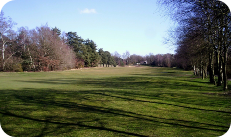
In October 1967 the first moves were made to provide a ‘proper clubhouse’, when a sub-committee under the leadership of Mr. Doug Parsons was formed to investigate the possibilities. In 1970 the dream became a reality when the clubhouse was opened and although extended and modified internally is still in use today. Doug must be credited with the success of the project and although many other members contributed time and expert skills during the building phase, it was Doug’s determination in dealing with the various authorities that enabled the finalisation of the project. Two other members noted in the minutes as providing an outstanding contribution were brothers Arthur and Jim Brown who continued to tend the object they helped to create for over 30 years.
The bar in the clubhouse was built by Jim and is still very well used today.
From the beginning of the Club until 1974 many members of Copthorne Golf Club and local dignitaries have supported the Club by acting as Presidents but three of the number deserve a special mention :-
B. H. Rendall Esq. (President from 1921-1928). It is obvious from the club minutes that he took a very active interest as he is recorded as attending every committee meeting and AGM. On leaving the district he presented the Club with a trophy which has been named ‘the Presidents Bowl’ which is awarded to the the winner of the competition of the same name which determines the Club champion.
F. Boyle Monkman Esq. (President from 1931-1938 and 1946-1947). Notable as another keenly interested in the welfare of the Club before the Second World War and although not able to play golf following an injury sustained during the hostilities, continued as President when the Club resumed its activities. He presented the Club with a silver cup in 1930 to commemorate the purchase of the Manorial Rights by Copthorne Golf Club which was named the Manor of Copthorne Cup and was designated in 1931 to be played for annually on Whit Monday, 36 holes Medal play under full handicap. This tradition continued until the mid 1990s when the format was changed mainly due to modern day family commitments restricting the number of members willing to play 36 holes in a day.
A. K. Irens Esq. (President from 1951-1973). A stalwart supporter of the Village Club and the longest serving President.
From a golfing point of view the Village Club has enjoyed a measure of success over the years, either in providing the individual winner or the winning team of premier events in the Artisan calendar.
In 1989 Simon Chapman became the AGA champion, emulating the success of his uncle, Spencer Chapman, 52 years b efore him. In 1980 Doug Arnold became AGA champion, a feat that he repeated in 1982, which probably makes him the most successful golfer in the Clubs history. The Sussex Artisans Golf Unions magnificent trophy, the John Slater Challenge Cup, has been won by Village club teams on seven occasions and many individual members have won their particular handicap group even if the team score is insufficient for victory. Today the Village Club is a happy mixture of members who have had their family roots firmly planted in the village area before the Club even started and other members who have arrived in the area due to the growth of Crawley as a New Town. All have a one thing in common, they enjoy golf as a game and respect the traditions built by former Club members.